Dear Patient,
You have been directed to this page because you have requested that we refer you for a vasectomy.
The first part of this document aims to provide you with all the necessary information you will need to be able to make an informed and balanced decision about whether or not a vasectomy is right for you.
The second part of this document invites you to answer questions. The purpose of these questions is to let us know whether or not we can refer you directly (i.e. no need for a doctor’s appointment) or whether you still have further questions (in which case one of our Clinical Team will call you).
If you reach the end of the document and you are happy to proceed, we will send your referral immediately and you will then be contacted by the nearest clinic which offers the procedure.
Overall, we hope that you find the document to be informative, and we hope
that it helps you in your decision making.
The Westgate Practice
Why consider a vasectomy?
A vasectomy might be right for you if:
- you do not want to have any children in the future
- you do want an effective, permanent and long-term method of contraception
It is important to note that:
- you should consider vasectomy to be irreversible
- reversal procedures are not routinely available on the NHS (i.e. you would need to pay to have this done) and they are often unsuccessful
What is a vasectomy?
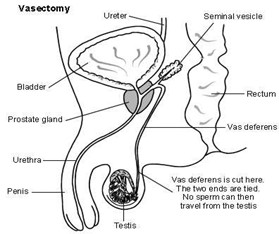
A vasectomy is a small surgical procedure which involves cutting the tube (‘vas deferens’ – please see the image above) which transports sperm from the testicle to the penis. This means that whilst you will still produce semen when you ejaculate it will not contain any sperm.
The procedure usually takes place in a clinic in the community (i.e. not in hospital). It is carried out using local anaesthetic (i.e. you will not need to be ‘put to sleep’) and it takes around 15 minutes. As soon as the procedure is done you can go home (i.e. you do not need to stay over).
How is a vasectomy carried out?
- Local anaesthetic is injected into a small area of the scrotum to ensure that you experience no pain during the procedure.
- A small cut is made in the scrotum on both sides and the vas deferens is located (it sits just underneath the skin).
- The vas deferens are then cut and both loose ends are tied off.
- The small cut is then usually closed with surgical tape or dissolvable stitches.
Quick Questions
What is the failure rate of a vasectomy?
The failure rate in 1 in 2000 (i.e. it is 99.95% effective). The usual cause of this is that the two ends of the tube manage to re-join inside the body.
What are the common side effects?
The most common side effect is pain, discomfort and bruising. In most cases the pain and discomfort will settle over a few days. In some cases, it will last several weeks or months and in 5% of cases the discomfort will be permanent.
What can I do to prevent this?
We recommend that for 7 days and nights after the procedure you wear tight-fitting underwear and avoid heavy lifting or strenuous exercise for 4 weeks after the procedure.
What are the risks of the procedure?
As with any surgical procedure infection and bleeding are the two main risks. If you develop excessive swelling and bleeding or if the area becomes hot and red and you develop a temperature, we advise you to give the practice a call.
Will it work immediately?
In theory the procedure will work as soon as the tubes are cut but you will be asked to provide a semen analysis 12 weeks after the procedure to ensure that it has worked. This is because sperm can sometimes be in the part of the tube after the point at which it has been cut, and it takes roughly 12 weeks for sperm to be broken down a reabsorbed.
We would recommend that you use other contraception until you have been advised that your sample shows no sign of sperm.
What if my sample at 12 weeks shows that I still have sperm in my ejaculate?
You will be tested every month until your ejaculate is completely sperm-free after which point you no longer have to use other contraception, and the procedure is considered a success.
What about my risk of contracting a sexual transmitted infection (STI)?
One of the disadvantages of a vasectomy is that if you were to have unprotected sex because there isn’t a barrier between you and your sexual partner, it offers no protection against STIs.
Will it affect my sex drive?
In a word, no. The hormone, testosterone, is responsible for sex drive. A vasectomy does not affect the production of testosterone in any way.
Will I still ejaculate?
You will still ejaculate as most of the constituents of semen are actually made in the prostate. The only difference will be that the semen itself contains no sperm.
How soon after a vasectomy can I have sex?
It largely depends on how you feel after the procedure but we usually advise waiting between 2 and 7 days.
Will a vasectomy put me at increased risk of prostate cancer?
The Faculty of Sexual and Reproductive Healthcare (FSRH) state that there is no evidence that vasectomies cause prostate cancer.
Thank you for taking the time to read through the information above.